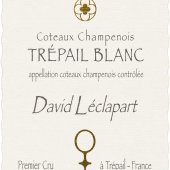
“David Léclapart’s 2020 Coteaux Champenois Trépail Blanc was, as ever, produced from barrels earmarked for his cuvée L’Artiste and underwent an extended élevage of 16 months—longer than that of the wines reserved for his Champagnes. In the glass, it opens with aromas of waxy citrus peel, green apple and dried white flowers, mingling with delicate smoky nuances and framed by its time in oak. Medium-bodied, satiny and almost ethereal in structure, it concludes with a saline-tinged finish. Yet, while the nose offers considerable complexity, the palate does not entirely rise to the same level of resonance. The wine was matured in barrels that are now in their second vintage and were originally acquired new. Drink: 2025-2029. 90 points
Since 1998, David Léclapart has been instrumental in putting Trépail on the international map and inspiring others in Montagne de Reims to adopt chemical-free farming practices. Today, he, along with his sons Martin and Léo, runs a 2.95-hectare estate, where the average vine age is 50 years. The estate has been Demeter-certified since 1998 and Biodyvin-certified since 2020.
“When I first took over the estate in 1996, the soil was compacted from years of chemical use,” explains Léclapart. “But now, it’s full of life, with all water being absorbed naturally by the soil. I only seeded a cover crop once, in 1999, and since then, the plants reseed themselves every year.” He was first introduced to biodynamics at the École d’Agrobiologie de Beaujeu, and he soon realized that it was more of a life philosophy than merely a technical approach. When it comes to plowing, Léclapart practices “binage” four to five times a year, plowing just 10 centimeters deep to aerate the soil and turn in the weeds. Of the 22 plots he owns, 21 are planted with massal selection vines.
Historically, Trépail was planted with Pinot Noir, but today, 95% of its southeast-facing slopes are devoted to Chardonnay. The clay-rich soils are particularly well-suited to Chardonnay, and the proximity of the vineyards to the forest provides a natural reservoir—an area that remains relatively cooler and more humid. This microclimate helps maintain higher natural acidity, an advantage in hot years like 2022 and 2023, though it can be challenging in cloudier and rainier vintages such as 2021 and 2024.
While Léclapart doesn’t own a press due to space constraints, his grapes are pressed at a friend’s nearby facility using a traditional Coquard press, dedicated solely to his fruit. His small winery, located at street level, has faced losses in hot years like 2018 and 2022 due to excessive levels of volatile acidity. In other years too, some volatility occasionally factors into the wine’s profile, making the experience slightly unpredictable. Depending on the cuvée, vinification takes place in both enameled steel tanks and barrels. Initially, Léclapart procured second-hand barrels from Burgundy; however, since 2019, he has exclusively acquired new barrels, primarily from Tonnellerie Ermitage, discontinuing his practice of purchasing second-hand vessels. Fermentation is conducted with native yeasts (while selected yeasts are used for the prise de mousse). Élevage lasts for 11 months, with full malolactic fermentation, and sulfites are typically only added during pressing.
His range consists of five Champagnes, three of which are blanc de blancs:
• L’Amateur, sourced from several plots across Trépail and vinified in enameled tanks, spends two years sur lattes.
• L’Artiste, produced from two old-vine plots planted in 1985 and 1974, is vinified equally in enameled tanks and oak barrels and spends three years on the lees in the bottle.
• L’Apôtre, a single-site wine from the lieu-dit La Pierre Saint-Martin, a plot rich in clay and silex, planted in 1946, is vinified entirely in oak and spends four years sur lattes. It’s the wine with the most mid-palate amplitude.
His most irregular cuvée—and the only blanc de noirs in his range—L’Astre, is made from Pinot Noir vinified entirely in wood and, since 2020, is bottled in dark glass to prevent light-taint, which had previously affected its reliability.
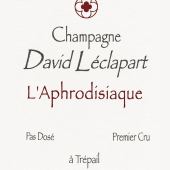
L’Aphrodisiaque, also vinified in oak, is a blend of different estate plots, typically produced in vintages when conditions are not optimal for vinifying the individual cuvées. Its composition generally consists of 80% Chardonnay and 20% Pinot Noir, although this ratio varies with the quality of each harvest.
Each of Léclapart’s expressive wines exhibits a distinct personality, reflecting both the place and the philosophy of their creator. They are all single-vintage, and each is disgorged without dosage, allowing the chalky signature of the place to shine through even more vividly.”
Kristaps Karklins, Wine Advocate (05/25)